
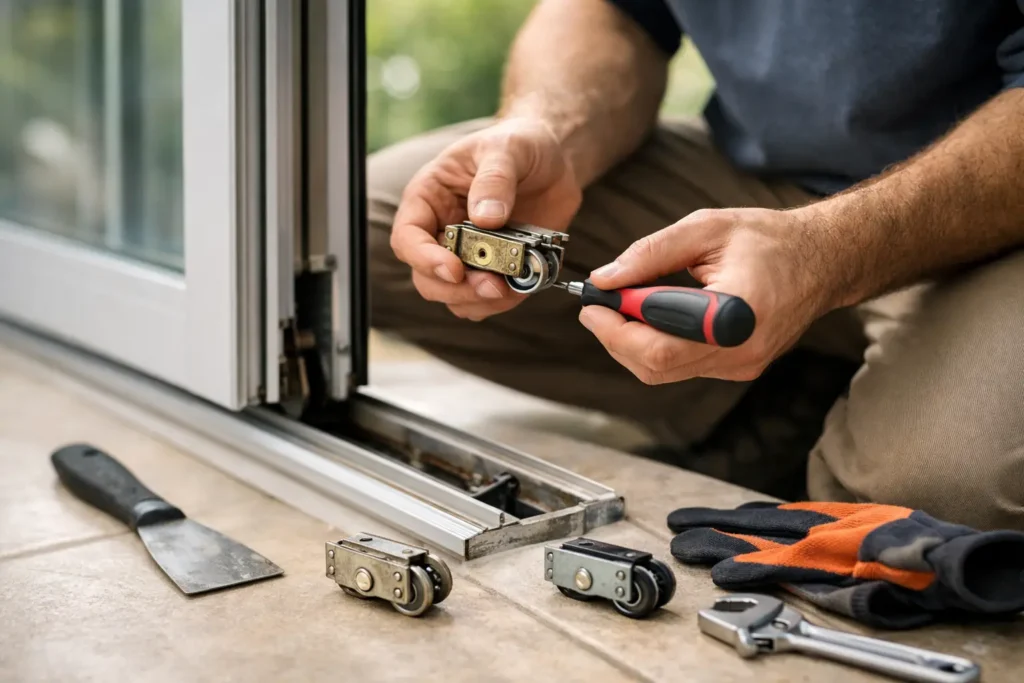
A sliding glass door that suddenly needs two hands to move is rarely just “sticking.” In many cases, the rollers beneath the door panel are worn, rusted, flat-spotted, or packed with debris. Learning how to replace sliding door rollers can help you understand the repair, but it also shows why the condition of the track matters just as much as the rollers themselves.
For South Florida homeowners, humidity, salt air, sand, and frequent use can wear out sliding door hardware faster than expected. Replacing the rollers can restore a smooth glide without the cost of replacing the entire patio door – provided the panel, frame, and track are still in good condition.
First, Confirm the Rollers Are the Problem
Rollers are small wheel assemblies installed at the bottom of a sliding door panel. They carry the weight of the glass and allow the panel to travel along the lower track. When they fail, the door may drag, scrape, jump, or become difficult to lock because it no longer sits squarely in the frame.
A dirty track can create similar symptoms, so start there. Vacuum out sand and loose debris, then wipe the track with a non-abrasive cleaner and a stiff nylon brush. Avoid using heavy grease or thick oils. They collect dirt quickly and can make the problem return sooner.
If the door remains hard to move after cleaning, inspect the adjustment screws near the bottom edge of the operating panel. A small adjustment may raise the panel enough to reduce dragging. If the door still feels heavy, makes grinding noises, or has visible wheel damage, replacement rollers are likely needed.
Track damage changes the decision. Deep grooves, bent rail sections, corrosion, or a flattened track can destroy new rollers quickly. Installing premium rollers on a damaged track may improve the door temporarily, but it will not be a lasting repair. In that case, the track should be repaired or replaced along with the roller assemblies.
What You Need to Replace Sliding Door Rollers
The right replacement roller is not universal. Sliding door rollers vary by door manufacturer, wheel diameter, housing shape, mounting position, and adjustment design. Taking out the old assembly before ordering parts is often the best way to ensure a match.
For a typical repair, you may need a Phillips screwdriver, flat-head screwdriver, utility knife, putty knife, vacuum, nylon brush, wood shims, work gloves, and a helper. Because glass patio doors are heavy and awkward, two people are strongly recommended. Larger insulated glass panels can weigh well over 100 pounds.
Quality matters here. Stainless-steel precision ball-bearing rollers are a better long-term choice for many Florida homes because they resist corrosion and provide smoother operation than low-grade assemblies. The least expensive roller may fit the door, but it may not hold up well in a humid, coastal environment.
How to Replace Sliding Door Rollers Step by Step
1. Prepare a safe work area
Clear furniture, rugs, and breakable items away from both sides of the door. Lay down moving blankets or cardboard where the door panel will rest. Keep children and pets out of the area while the panel is removed.
Unlock the door and open it several inches. Locate the roller adjustment screws, usually found at the lower corners of the sliding panel. Turn them counterclockwise to lower the rollers as far as possible. This gives you more clearance to lift the panel out of its frame.
2. Remove the sliding panel
Many patio doors have a stop or anti-lift block at the top of the frame. Remove it first if present. With one person on each side of the panel, lift the door straight up into the upper track, then pull the bottom edge toward you and out of the lower track.
Do not force the panel. If it will not lift out, check again for top stops, screws, fixed panels, screen doors, or trim pieces that may be holding it in place. Forcing a heavy glass panel can damage the frame, crack the glass, or cause an injury.
Set the panel carefully on its edge over padded support. Avoid placing it flat on an uneven surface or directly on concrete.
3. Remove the old roller assemblies
The roller housing may be held in place by screws, a retaining clip, or the door frame itself. Remove the screws or release the retainer, then slide or pry the old roller assembly out carefully. Take a clear photo before removing it completely so you can compare the orientation of the replacement part.
Look closely at the old wheels. Rust, worn bearings, chipped nylon, or a wheel that no longer turns freely confirms the issue. Also inspect the bottom rail of the door for corrosion or damage around the roller opening. If the aluminum frame is badly deteriorated, a simple roller replacement may not be enough.
4. Clean and inspect the track
With the panel out, you can properly inspect the lower track. Remove debris from the channel and check the raised rail where the wheels travel. A light buildup of dirt can be cleaned. Minor roughness may be manageable. But sharp edges, severe pitting, or a rail worn nearly flat should be addressed before new rollers are installed.
This is the point where many do-it-yourself repairs fall short. New rollers cannot compensate for a damaged running surface. The door may glide for a short time, then begin dragging again as the wheels wear against the track.
5. Install the new rollers
Position the new roller assembly in the same direction as the old one. Reinstall all screws or retaining hardware without overtightening them. Confirm that each wheel turns freely and that the adjustment screw engages correctly.
If one roller failed, replace both bottom rollers when possible. They have carried the same load for the same amount of time. Replacing only one can leave the door uneven and may shorten the life of the remaining old roller.
6. Reinstall and adjust the door
With your helper, lift the panel into the top track first. Swing the bottom inward and lower it onto the bottom rail. Reinstall any anti-lift blocks or top stops you removed.
Turn the adjustment screws clockwise in small, even increments to raise the door. The goal is for the panel to glide smoothly while remaining level and seated correctly against the frame. Test it several times from fully open to fully closed.
A properly adjusted door should close without scraping, latch without lifting the handle excessively, and maintain even gaps around the frame. If it rolls smoothly but will not lock, the door may need additional alignment or lock adjustment.
When to Call a Sliding Door Specialist
Replacing rollers is manageable for an experienced homeowner with the right tools, a helper, and a door that is otherwise sound. It is less suitable when the glass is oversized, the panel is difficult to remove, the track is damaged, or the door frame shows corrosion.
Call a professional if the door has broken glass, a bent frame, a damaged track, recurring roller failure, or a lock that no longer lines up after adjustment. These symptoms can point to a larger issue than worn wheels. A qualified technician can inspect the full system – rollers, track, frame, handles, locks, and glass alignment – rather than replacing one part and hoping for the best.
For homeowners in Southeast Florida, Protech Sliding Doors can assess whether a roller replacement is the right repair or whether the track and hardware need attention too. A free estimate can make that decision clearer before you spend time removing a heavy door panel.
A patio door should glide with a light push, close squarely, and lock securely. If yours is fighting you every day, do not wait until the rollers fail completely. Addressing the problem early can protect the track, improve security, and make your indoor-outdoor space comfortable to use again.